

Imagine standing at the cash counter of a hospital, your loved one just referred from a district government hospital.
Instead of focusing on their care, you’re running from one counter to another, trying to arrange the hospital fees — because treatment won’t begin until the bills are cleared.
You don’t know how much the treatment will cost, what kind of medication or procedures will be needed, or how long it will take.
In panic, you start calling relatives and friends, doing everything possible to arrange the money.
Meanwhile, your dependents look at you with eyes full of hope — and you know, you can’t afford to let them down.
Two Possible Outcomes
- You have savings.
You dig deep into your hard-earned money to cover hospital bills.
But remember — this isn’t a simple viral fever.
We’re talking about major medical emergencies like surgery, accidents, or critical illness — the kind that can drain years of savings in a few days. - You don’t have enough savings.
You borrow money, take loans, or fall into debt traps, paying interest long after your loved one has recovered.
In 2018, the Government of India reported that over six crore Indians are pushed into poverty every year due to out-of-pocket medical expenses.
What is a Health Insurance Policy?
The financial risk during a medical emergency is transferred from you to the insurance company in exchange for a regular premium—a relatively small amount compared to the large sum assured under the policy.
This is one of the most crucial financial steps and should never be ignored. In fact, it deserves consideration before life insurance plans offered by LIC or any private insurer.
However, while the concept sounds simple, choosing the right health insurance plan from numerous insurers offering a wide range of schemes can be confusing. But don’t worry—it’s not rocket science either. In this blog, we’ll break down every key aspect of health insurance step by step, helping you understand how to choose the plan that best fits your needs and lifestyle.
Different Hospital Expenses
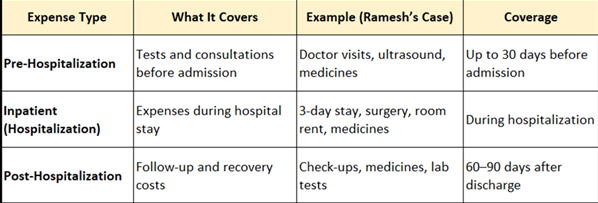
In case of an emergency or serious illness, medical expenses typically occur in three stages:
- Pre-Hospitalization Expenses
- Inpatient (Hospitalization) Expenses
- Post-Hospitalization Expenses
Let’s understand each stage with a simple example.
For Example, Ramesh experiences severe abdominal pain. The doctor suspects a kidney-related issue. In this context, let’s explore the different types of medical expenses involved.
1. Pre-Hospitalization Expenses
These are the expenses incurred before formal admission to the hospital.
They are directly related to the illness for which the patient is eventually hospitalized.
Most insurance plans cover these expenses for up to 30 days before hospitalization.
Examples (Ramesh’s case):
- Doctor consultation and diagnostic tests (ultrasound, blood tests, urine tests)
- Specialist consultation with a nephrologist (kidney specialist)
- Medicines for pain relief and infection control before admission
- Ambulance charges if the condition worsens and immediate hospitalization is required
2. Inpatient (Hospitalization) Expenses
All the expenses incurred during the hospital stay fall under this category.
Suppose doctors confirm that Ramesh has a kidney stone that needs to be surgically removed, and he is hospitalized for 3 days.
Examples:
- Room rent and nursing charges for 3 days
- Doctors’ and surgeons’ fees
- Operation theatre and anesthesia charges
- Medicines and supplies used during hospitalization
- Diagnostic tests during stay (creatinine test, blood pressure monitoring, etc.)
- Consumables like gloves, syringes, and surgical dressings
3. Post-Hospitalization Expenses
After being discharged, patients often need follow-up care, medicines, and routine tests to ensure full recovery.
Health insurance policies usually cover these expenses for up to 60–90 days after discharge.
Examples (Ramesh’s case):
- Follow-up doctor consultations
- Medicines and antibiotics are prescribed after surgery
- Lab tests to monitor infection and kidney recovery
- Any post-surgery ultrasound or scan
Terms used in health insurance:
Cashless Facility :
The insurer directly settles the bill with the network hospital. You don’t have to pay any upfront fee.
Co-payment :
A fixed percentage of the claim amount that you must pay from your own pocket. A higher co-pay reduces the premium but increases your share at the time of claim.
Cumulative Bonus :
Each claim-free year, extra coverage is added, usually as a percentage of the base sum insured.
Daycare Procedures :
Treatment that requires less than 24 hours of hospitalization.
Deductible :
The pre-decided amount you must pay before the insurance benefit starts.
Exclusions :
Conditions, situations, or treatments that are not covered by the policy.
Free-look Period :
After receiving the policy, a certain number of days is given to review and cancel it.
Grace Period:
After the premium due date, a window is given to renew the policy.
Network Hospital :
A hospital partnered with your insurer for cashless treatment.
Keep in mind that a larger network of the insurer gives you easier access during emergencies
No Claim Bonus :
A reward given by the insurer for not claiming in a policy year. Usually, it offers an increase in the sum insured or a discount during renewal.
Portability :
Option to switch insurers without losing benefits like waiting period, no-claim bonus.
This feature gives policyholders the freedom and protection from being locked into an unsatisfactory insurer.
Pre-hospitalization Expenses :
Expenses incurred before hospitalization. Includes diagnostic tests, doctor consultation fees, medications, etc.
Post-hospitalization Expenses :
Medical costs incurred after discharge from the hospital. Medication, tests, follow-up check ups, and doctor consultations are some of the related expenses.
Pre-existing Disease :
Any illness or condition you already had before buying the policy.
Premium :
The annual price you pay to maintain your policy. It depends on your age, sum insured, health status, and type of coverage.
Reimbursement Claim :
You pay the bills first, and after verification, the insurer reimburses you later. This normally happens when the hospital is not in the insurer’s cashless network.
Restoration Benefit :
If your coverage limit (sum insured) is exhausted, your insurer restores it so you remain protected for the rest of the year.
Depending on the policy, full or partial restoration of the sum insured is credited if the original sum insured is about to expire.
Rider :
Optional add-on coverage, such as critical illness, maternity, or accidental benefits. Customize your policy for better protection.
Room Rent Limit :
During hospitalization, the maximum daily room charge is covered by the insurer.
Sub-limit :
A cap or restriction placed by the insurer on how much they will pay for a specific type of expense — even if your total sum insured is higher.
Sum Insured :
Defines your overall financial protection limit, i.e., the maximum amount the insurer will pay in one policy year.
Waiting Period :
Initial duration after buying a health insurance policy during which certain illnesses, pre-existing diseases, or treatments are not covered.
This period determines when the full benefits of the policy begin.
Other related aspects, such as types of health insurance policies, how to choose a health insurance policy, and what the ideal coverage should be, will be discussed in upcoming blogs.