

Introduction
A fascinating trend shows that restaurant occupancy drops by nearly 30% in the last week of the month compared to the start. You can probably guess why — people are tight on budget. In simple terms, they’ve run out of money.
.
You rely on your paycheck, and when it arrives, you celebrate — dining out, shopping, treating yourself. But as the month progresses, those early splurges catch up, and by the end, things often get worse.
In this article, you’ll discover practical budgeting tips to gain better control of your money and save more effectively.
What Is Budgeting?
Remember those days of pocket money — planning to buy your favorite snack after school, chipping in for a cricket ball, or saving for a comic or a visit to the internet café?
That was budgeting — managing your income (pocket money), spending on needs and wants, and saving for future goals.
In a more structured sense, budgeting is the process of planning, tracking, and managing income and expenses to achieve financial goals
.
Why Do We Avoid Budgeting?
Before payday, your list of payables is already long — rent, EMIs, credit card bills, groceries, clothing, and more. By the end of the month, nothing’s left after all the planned and unplanned expenses.
You might think: “What’s the point of budgeting?” or “Where is the money for long-term investments?”
.
This situation exists because of poor budgeting or no budgeting at all. To break this cycle, you must put an end to unplanned money management.
Let me be clear — you have to do it. If not now, you’ll feel the consequences a few years down the road.
.
How to Plan a Monthly Budget
A. Monitor Your Cash Flow
Cash flow is simply how much money comes in as income and how much you spend. If your income exceeds your spending, congratulations — you are in positive cash flow!
- Track all income sources: You might have a single income or multiple sources. Keep a record of each if you haven’t already.
- List and categorize your expenditures into ‘Needs’ and ‘Wants’.
Needs (Essentials): These are non-negotiable. Without them, survival becomes difficult.
Examples: Rent, utilities, groceries, healthcare, education.
Wants (Non-Essentials): These improve comfort and lifestyle but are not essential.
Examples: Eating out, vacations, streaming subscriptions, updated gadgets.
.
B. Sort Your Accounts
Imagine using a single account for every transaction — paying rent, bills, groceries, and everyday expenses. By the month-end, it becomes overwhelming to track your hard-earned money.
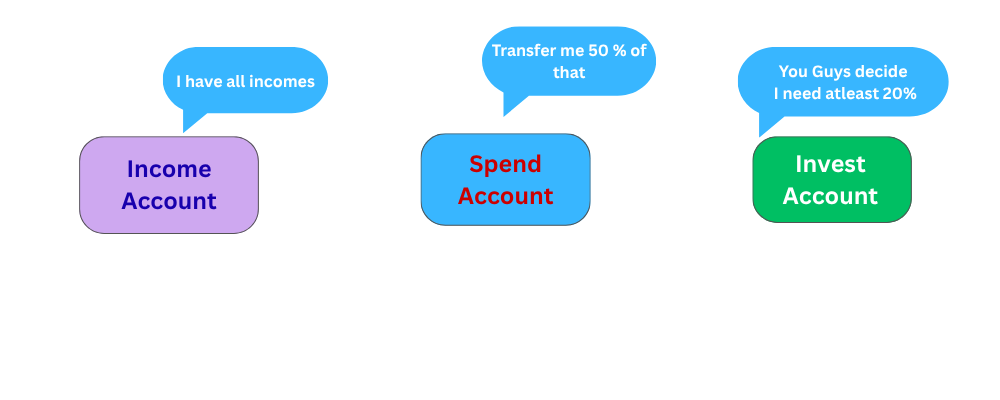
A powerful money management technique is the 3-Account Formula:
- Income Account – Salary is credited to this account.
- Spend Account – For daily needs and wants.
- Invest Account – For savings and investments.
If you currently have only one account, create two zero-balance accounts for spending and investing. Naming them clearly helps psychologically; each account serves only its intended purpose.
Tip: Don’t just maintain minimum balances. Treat each account as a tool to control your money, not just a bank requirement.
.
C. Distribute First — The 50:30:20 Rule
Wondering how to save consistently? It’s simple — allocate money first, before spending.
- 50% → Needs
- 30% → Wants
- 20% → Savings & Investments
Implementation:
- At the start of the month, transfer 50% of your income to the Spend Account.
- Transfer 20% to your Invest Account for savings and long-term investments.
By allocating money upfront, saving becomes automatic rather than an afterthought.
.
D. Observe for Three Months
While distributing your income, 30% remains in the Income Account. For your wants, spend only from the Spend Account.
For your wants, transfer the required amount to the Spend Account, transfer the remaining to the Invest Account for a goal in the near future.
Track your expenses for at least three months. This will help you understand your spending patterns and determine how much you can realistically invest each month. Ideally, investments should not fall below 15% of your total income.
.
E. Guide Growth
Once your budgeting pattern is established, you’re already investing in essential instruments like:
- Emergency Fund
- Term Insurance
- Health Insurance
- Long-term investments
If you run out of money mid-month, recharge the Spend Account from the Income Account.
- Never transfer money from the Invest Account to the Spend Account.
As your income grows, tweak the allocation to your Invest Account and redistribute the extra funds across your instruments.
Example:
If your monthly income increases from ₹50,000 to ₹60,000 (a 20% rise):
- Previous investment: ₹10,000 → Increase to ₹12,000
- Allocate the extra ₹2,000 as:
- ₹1,000 → Long-term SIPs or mutual funds
- ₹500 → Emergency Fund
- ₹500 → Health/Term Insurance
- ₹1,000 → Long-term SIPs or mutual funds
Investments should grow alongside your income — that’s how financial freedom compounds over time.
.
Conclusion
Budgeting isn’t about limiting yourself — it’s about gaining control and clarity over your money. With a structured plan, consistent tracking, and timely adjustments, you can turn budgeting into a habit that builds financial confidence and long-term stability.
.
And don’t you think MSD is an OG when it comes to calm control and strategy?
Exactly! That’s the way to remember the simple formula for budgeting tips for beginners.
- M – Monitor Cash Flow
- S – Sort Accounts
- D – Distribute First
- O – Observe Three Months
- G – Guide Growth
Keep the MSD-OG framework in mind — stay calm, stay consistent, and let your money play smart, just like MSD does on the field.